AJS Furniture AJS Furniture

Top 10 Wardrobe Door Styles That Save the Most Space?

Time:2026-09-25 Author:Amelia
0%

Choosing wardrobe doors is not merely a style decision. It changes how much clear floor space remains beside the bed, desk, or dresser. Which wardrobe door style saves the most space? The answer depends on the room’s layout, the opening width, and how you use the wardrobe each day.

Dieter Rams, the influential industrial designer, offered a useful principle: “Good design is as little design as possible.” Applied here, that means choosing a door that works without demanding unnecessary clearance. Sliding doors need no swing area, making them a strong choice for narrow bedrooms. But they reveal only part of the wardrobe at once. Bifold doors fold back compactly, while pocket doors disappear into the wall but may require extra construction. Small details matter. A handle can catch on nearby furniture.

This guide compares ten wardrobe door styles, from sliding and bifold options to tambour and hinged designs. Each has trade-offs in access, installation, cost, and appearance. Measure the room with the bed and drawers in place, not just an empty floor. A few centimetres can change the result. And the tightest-fitting door is not always the easiest one to live with.
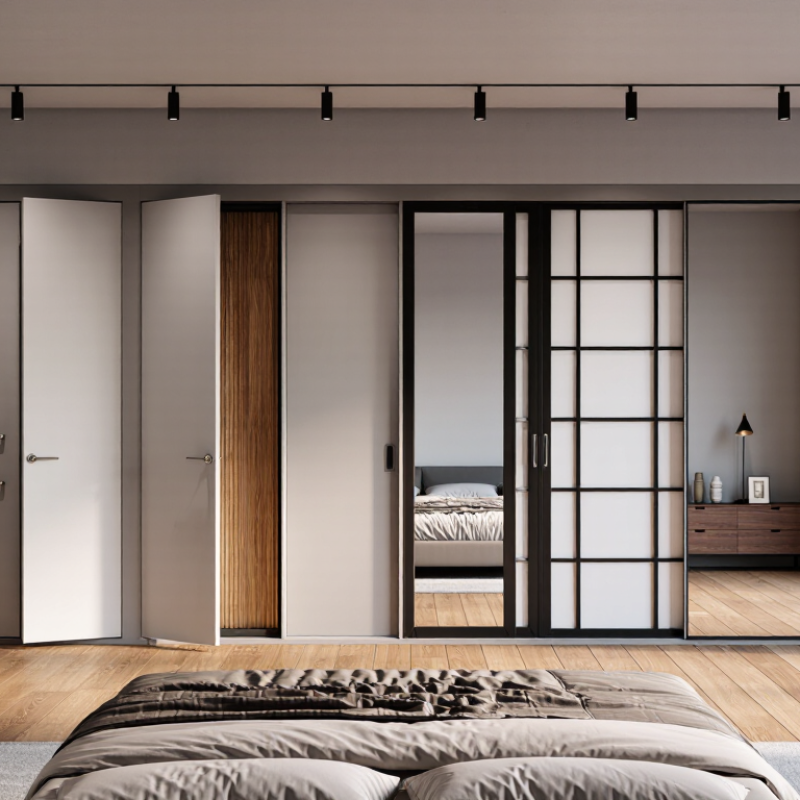
Top 10 Wardrobe Door Styles That Save the Most Space?

How Wardrobe Door Styles Affect Space Use

Wardrobe door styles change how much clear floor space remains around a closet. Hinged doors need room to swing outward, which can conflict with a bedside table or narrow walkway. Measure the full door arc, not just the wardrobe width. A few extra inches can make daily access feel awkward.

Sliding doors keep the floor clear, but they usually reveal only part of the wardrobe at once. That can make choosing clothes slower when shelves sit behind the covered panel. Bi-fold doors fold back with less swing space than standard hinged doors, though their hardware needs enough clearance to move freely. Pocket doors disappear into the wall, but installation may be difficult where pipes, wiring, or structural framing occupy that space. No style is perfect; the best fit depends on the room and how you use it.

Tips: Tape the door’s opening path on the floor before choosing a style. Stand beside the bed and test whether drawers, baskets, and walking routes still work. Check track depth and floor level for sliding doors, since a slightly uneven surface can affect smooth movement. Small details matter.

Room Measurements and Conditions to Consider

Room Measurements and Conditions to Consider

Before choosing a space-saving wardrobe door, measure the room, not just the opening. Record the width, height, and depth at several points; older walls are rarely perfectly square. Note skirting boards, handles, radiators, ceiling slopes, and light switches. A sliding door may save swing space, but its panels still need clear wall space to overlap. A hinged door needs room to open without hitting a bed or blocking a route. Measure twice. I once overlooked a projecting window sill; small details can undo a neat plan.

Allow enough space to stand, open drawers, and reach hanging clothes. The NKBA’s kitchen-planning guidance uses a 36-inch walkway as a circulation benchmark, though it is not a wardrobe-specific rule. For accessible layouts, the 2010 ADA Standards specify a 30-by-48-inch clear floor space for a wheelchair approach, and a 60-inch turning space where turning is required. These figures help test whether a room feels workable, but they do not guarantee comfort for every household. Check the finished floor, too: thick carpet can affect door tracks, while uneven flooring may cause sliding panels to drift. Mark the proposed door path with masking tape, then walk through it carrying a laundry basket. It is an imperfect test, but often revealing.

Ten Wardrobe Door Styles That Save Space

Ten Wardrobe Door Styles That Save Space

Compact rooms need doors that do not claim a wide swing zone. NAHB’s analysis of U.S. Census data puts the average new single-family home at 2,411 square feet in 2023. That figure is context, not a closet-design rule. Measure the doorway, nearby furniture, and access to drawers before choosing. Standard bypass sliders overlap neatly. Top-hung sliders keep floor tracks clear. Three-panel sliders expose more of the wardrobe opening. Mirrored sliders combine access with a full-length reflection. Pocket doors slide into the wall. They need a suitable cavity. Bifold doors fold back with modest clearance. Tri-fold leaves gather more tightly. Accordion doors stack into a narrow bundle. Tambour doors roll upward, leaving the floor clear. Corner-folding doors suit awkward layouts.

Small details matter. Check handles against bedside tables, and confirm sliding panels leave enough access to every section. A deep wardrobe may need wider openings than a shallow one. Not always obvious. Pocket doors can be difficult to retrofit around wiring or wall framing. Folding systems also need room for their panels to gather. I once assumed a slider would solve everything; it didn’t. The opening still felt cramped because the wardrobe interior was poorly arranged. A simple tape outline on the floor can reveal the likely door sweep before installation.

Top 10 Wardrobe Door Styles That Save the Most Space

Rank Door Style Typical Outward Clearance Access When Open Best For Space-Saving Consideration
1 Sliding Doors None beyond the wardrobe front Usually about half the wardrobe opening at a time Narrow bedrooms and wardrobes along walkways Panels slide across one another, so they do not swing into the room. The overlapping panels limit simultaneous access.
2 Tambour (Roll-Up) Doors None beyond the wardrobe front Can expose most or all of the opening, depending on the design Compact built-in storage and shallow wardrobes Flexible slats roll into a housing instead of swinging out. The roll housing takes up some internal or side space.
3 Pocket Doors None beyond the wardrobe front Can expose nearly the full opening when panels retract Built-ins planned alongside suitable wall or cabinet cavities Panels slide into a pocket, keeping the floor area clear. The cavity needs space and may complicate installation or later repairs.
4 Accordion-Fold Doors Low; the folded stack projects slightly from the opening Often exposes most of the opening Small rooms where wider access is useful Multiple connected panels fold together rather than swinging as one full-width leaf. The folded stack still occupies some opening space.
5 Bifold Doors About half a panel width, depending on the hardware and configuration Usually exposes most of the opening Closets where sliding doors would block too much access Paired panels fold toward the sides. They need less swing room than full-width hinged doors, but still project into the room when open.
6 Multi-Track Sliding Doors None beyond the wardrobe front Can provide a wider opening than a two-track system Wide wardrobes where access to more sections matters Panels run on separate tracks, allowing more panels to stack to one side. Extra tracks and panels require suitable frame depth.
7 Wardrobe Curtain None beyond the wardrobe front Can expose the full opening when drawn aside Very tight budgets, rentals, or open shelving A curtain uses no hinged-door swing space. It needs a clear area to gather at the side and provides less sound and dust protection than a rigid door.
8 Top-Hung Sliding Doors None beyond the wardrobe front Usually about half the opening at a time for a two-panel setup Rooms where a floor track would be inconvenient The panels travel on an upper track, keeping the floor clear. The wall or cabinet structure must be suitable for the door’s weight.
9 Corner Bifold Doors Low to moderate; varies with the corner layout Can open across two adjoining wardrobe sections Corner wardrobes and L-shaped storage Folding panels can make a corner easier to access without a pair of full-width swinging doors. Hardware and panel layout need careful planning.
10 Open Wardrobe (No Doors) None Full access at all times Alcoves, dressing areas, and highly compact rooms Removing doors eliminates swing and track space. Clothing and stored items remain visible and receive less protection from dust.

Clearance descriptions are comparative and depend on panel size, track depth, hardware, and installation. For reference, a hinged door with a 600 mm-wide leaf typically needs roughly 600 mm of clear swing space in front of the wardrobe.

Comparing Access, Installation, and Storage Trade-Offs

Top 10 Wardrobe Door Styles That Save the Most Space?

Comparing Access, Installation, and Storage Trade-Offs

Sliding, bypass, and mirrored sliding doors need little clearance, but usually reveal only part of the wardrobe at once. Hinged doors offer full access; allow roughly one door-width of swing space. Bifold and concertina doors fold outward, saving some clearance while needing careful track alignment. Pivot doors create a striking opening, though their swing can still obstruct a narrow room. Pocket doors disappear into wall cavities, but installation may require structural changes. Tambour doors roll upward or sideways, while curtains and flush panels are simpler alternatives with different levels of privacy and finish. There is no universal winner.

Installation changes the real cost of saving space. The 2024 U.S. Houzz & Home Study reported a median home renovation spend of $24,000 in 2023; it does not compare wardrobe doors, but shows why measuring and planning matter. Check ceiling height, floor level, handle projection, and nearby drawers before choosing. A sliding track may tolerate a tight walkway, yet an uneven floor can make operation frustrating. Pocket doors need a suitable cavity. Even a neat plan can miss a coat sleeve.

Tips: Tape the door’s swing or opening onto the floor before ordering. Test access to the far corners, not just the center. Check shelving depth against the door track, and leave room for rails, hinges, or folded panels. Small detail. Measure twice, then reconsider.

Choosing the Best Space-Saving Wardrobe Door

Choosing the best space-saving wardrobe door starts with measuring the room, not choosing a style from a picture. Sliding doors need no outward swing, so they work well beside a bed or in a narrow hallway. Measure the opening and allow enough wall space for the panels to slide fully. One drawback: you usually cannot open the entire wardrobe at once. That can make finding a sweater behind the other panel mildly annoying.

Bi-fold doors fold back and reveal more of the wardrobe at once, but they still need some clearance. Check that the folded panels will not bump a bedside table or radiator. Hinged doors are often easiest to access and repair, yet they need the most open floor space. There is no perfect choice. A small room with awkward corners may need a compromise.

Tips: Mark the door’s swing or slide area on the floor with masking tape before ordering. Stand where you usually get dressed and check whether drawers, handles, or laundry baskets block access. For sliding doors, inspect the floor track and ceiling line; uneven surfaces can make panels stick. Keep a clear path to the clothes you use daily. Measure twice. A few millimetres matter.

Top 10 Wardrobe Door Styles That Save the Most Space

Compare the estimated room clearance needed to open common wardrobe door styles. Lower values mean less outward space is needed.

These are geometry-based estimates, not universal product measurements. The comparison assumes a 60 cm door leaf; segmented folding-door estimates reflect narrower panels. Sliding, pocket, and tambour doors need no outward swing clearance, though installation space and access can vary.

FAQS

Why should I measure a wardrobe door’s opening path?

Hinged doors need room to swing outward. Measure the full arc, not just the wardrobe width. A few inches can block a bedside table or narrow walkway.

Which door styles can save floor space?

Options include bypass, top-hung, three-panel, and mirrored sliders. Pocket, bi-fold, tri-fold, accordion, tambour, and corner-folding doors are other choices. Hinged doors need the most swing space.

What is the main drawback of sliding doors?

They keep the floor clear, but usually show only part of the wardrobe. A sweater behind the covered panel may take longer to find. Mildly annoying.

Do bi-fold doors need clearance?

Yes. Their panels fold back, but still need space to gather. Check nearby furniture, drawers, and radiators before choosing them.

Are pocket doors suitable for every room?

No. They slide into a wall cavity, which may contain pipes, wiring, or framing. Retrofitting can be difficult.

What should I check before installing sliding doors?

Measure the opening and space for the panels to slide fully. Check track depth and floor level. Uneven surfaces can make panels stick.

How can I test a door style before ordering?

Mark its swing or slide path on the floor with masking tape. Stand beside the bed and check drawers, baskets, and walking routes. Small details matter.

Will space-saving doors fix a cramped wardrobe?

Not always. I once assumed a slider would solve everything, but the interior still felt cramped. Arrange daily-use clothes within easy reach.

Conclusion

Wardrobe door styles affect how much floor and wall space remains available, but the best choice depends on the room’s dimensions, layout, and storage needs. Sliding, bi-fold, folding, pocket, tambour, and curtain-style doors can reduce the clearance needed for a swinging door, while pivot, hinged, and other designs may suit rooms with more open space. Before choosing, measure the wardrobe opening, nearby furniture, ceiling height, and any obstacles that could limit installation or access.

Which wardrobe door style saves the most space depends on the conditions: sliding doors need little clearance in front, while pocket doors can clear the opening completely if the wall can accommodate them. Each option has trade-offs in access, installation complexity, and how much of the wardrobe can be reached at once. Compare these factors alongside durability and storage habits to select a practical door that fits the room without compromising everyday use.

Amelia

Amelia

Amelia is a seasoned marketing professional with a wealth of expertise in our company’s core offerings. With an unwavering passion for driving growth and innovation, she plays a pivotal role in shaping our marketing strategies and enhancing brand visibility. A key aspect of her responsibilities......