AJS Furniture
What is the best lighting for walk-in closets? The answer depends on visibility, color accuracy, ceiling height, and personal routines. No single fixture wins every closet.
The U.S. Department of Energy reports that certified LED bulbs use at least 75% less energy than incandescent lighting. They also last up to 25 times longer. That matters in closets where lights may switch on repeatedly throughout the day. ENERGY STAR guidance also supports efficient LEDs with suitable brightness and color quality. For clothing, a color-rendering index of 90 or higher can reveal navy, black, and brown more accurately. Otherwise, that “black” jacket may look surprisingly blue outdoors.
The Lighting Research Center emphasizes that light affects human alertness and biological timing. Lighting researcher Mariana Figueiro explains, “Light is the most powerful synchronizer of the human circadian system.” For a walk-in closet, warmer evening light and moderate brightness may feel calmer than harsh, cool-white light. Motion sensors, vertical shelf strips, and recessed ceiling fixtures can create layered illumination. Small details matter. Shadows hide stains. Glare distorts mirrors. Poorly placed downlights can spotlight your head instead of your clothes.
This guide compares ten practical lighting options, including LED panels, track lights, puck lights, and illuminated wardrobes. The best choice may still require adjustment after installation. Measure first. Test colors at different times. A beautiful fixture is not automatically useful. Reliability comes from balanced brightness, high color accuracy, safe installation, and controls that fit real habits.
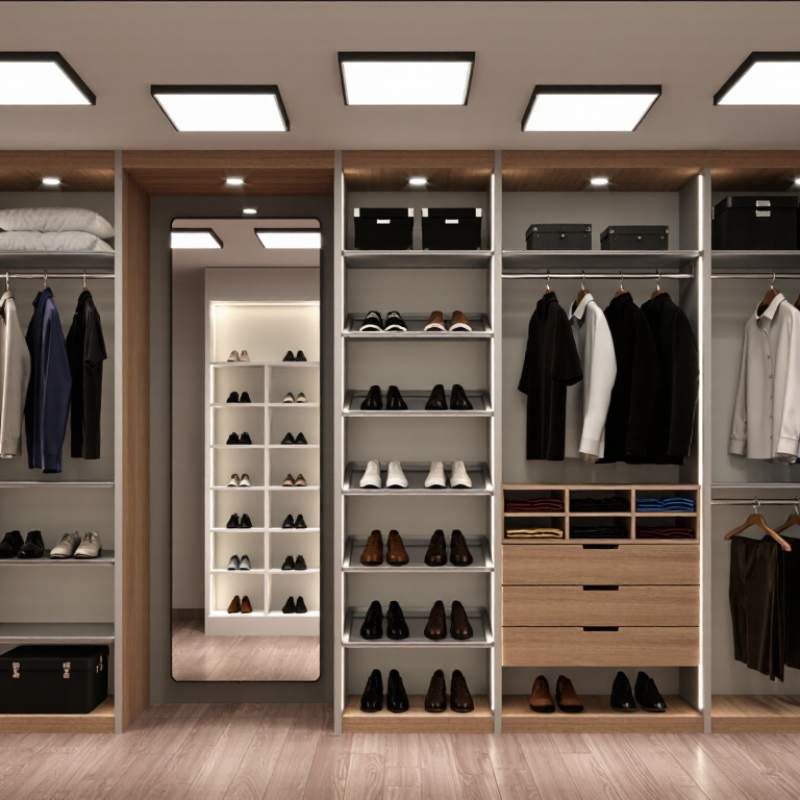
A walk-in closet needs more than a bright ceiling fixture. The Illuminating Engineering Society recommends about 300–500 lux for dressing areas. This range helps reveal fabric colors, stains, and subtle differences between dark clothing. Measure light at the shelves, hanging garments, and mirror. The floor may look bright while your clothes remain poorly lit.
The ten best lighting approaches include recessed downlights, linear ceiling fixtures, track lights, flush mounts, pendant lights, wall sconces, illuminated mirrors, LED strips, motion-activated lights, and adjustable spotlights. Layering usually works better than relying on one source. Place even overhead lighting between storage sections. Add vertical light near the mirror. Install strips under shelves when lower garments disappear into shadow.
Choose light with good color rendering, ideally a CRI of 80 or higher. A neutral color temperature around 3000–4000K often feels clear without looking harsh. Avoid placing strong fixtures directly above your head. They can create shadows beneath your eyes and chin. I have seen attractive closets become frustrating dressing spaces because designers judged brightness by appearance alone. A basic lux meter can challenge that assumption. The target is practical, not sacred. Clothing color, ceiling height, and surface finishes can change the result. Test the space with winter coats, pale shirts, and dark trousers before final installation.
Walk-In Closet Lighting Basics: IES-recommended 300–500 lux for dressing areas
This chart presents practical illuminance targets for common walk-in closet tasks. General dressing areas are typically designed within the 300–500 lux range, while detailed tasks such as mirror use and color matching benefit from the upper end of that range. Floor circulation can use a lower level because it does not require close visual work.
Illuminance is measured in lux. Actual levels should be verified on site because ceiling height, surface reflectance, fixture distribution, and diffuser quality affect the final result.
A walk-in closet works best with layered light, not one bright bulb. In my lighting layouts, I treat it as a small dressing room. LED ceiling panels provide broad, efficient illumination with little heat. Recessed downlights keep the ceiling clean, but spacing matters. Poor placement can leave shelves in shadow. Track lighting adds flexibility when storage changes. Adjustable heads can aim toward drawers, mirrors, or hanging sections. Linear LED fixtures create an even glow along a long ceiling. Choose a high color rendering index, ideally CRI 90 or above. It helps navy, black, and white fabrics look more truthful.
LED strip lighting under shelves reveals shoes and folded clothes without flooding the room. Diffusers reduce harsh points. Pendant fixtures add character, yet they need clearance from doors, rods, and heads. Flush-mount fixtures suit low ceilings and narrow walk-ins. Surface-mount lights offer similar practicality when recessed installation is difficult. Wall sconces can brighten a mirror, while under-cabinet puck lights target smaller storage zones. These ten fixture types serve different jobs. Mixing them often feels more natural than forcing one design everywhere.
Motion-activated fixtures are useful when both hands are full, but test the sensor before installation. I once underestimated a wardrobe’s height; the sensor missed movement behind it. That small flaw became irritating quickly. Check lumen output, beam angle, switch location, and ventilation before choosing by appearance alone. Around 3000K to 4000K usually feels practical without making white clothes look yellow. Electrical connections should meet local requirements and use a qualified professional when needed. Too much brightness is not better. Glare can hide detail.
A walk-in closet needs more than brightness. It needs honest color. Choose lighting with a Color Rendering Index of 90 or higher, especially when matching navy, beige, gray, or deep red clothing. A high CRI source reveals subtle differences that ordinary lighting can hide.
Color temperature matters too. Lighting near 2700K creates a soft, warm atmosphere, but it can make white shirts look yellow. Around 3000–3500K gives clothing a more balanced appearance. A cooler 4000K setting feels crisp and works well near mirrors, though it may seem slightly clinical. I usually prefer about 3500K for daily dressing.
Test it in the actual closet.
Place a shirt, belt, and pair of trousers beneath the fixture. Then compare them near a window. This simple check can expose green or gray shifts before installation is complete. Look for fixtures with strong red rendering, often supported by an R9 value above zero, because red tones can appear dull under weak light.
Use even ceiling light with vertical illumination near shelves and mirrors. Otherwise, your face may look clear while hanging clothes remain shadowed. I once chose a bright fixture with poor color quality, and the closet looked impressive but made two black garments appear almost identical. Brightness alone was not enough. A dimmable fixture also helps, although excessive dimming can sometimes change the light’s color slightly.
A walk-in closet works best when its lighting is layered, not simply bright. Ambient illumination should fill the room evenly and reduce harsh shadows. A flush ceiling fixture or recessed lights can provide this foundation. Choose a high color-rendering light source, ideally above 90, so clothing colors look closer to daylight. Keep it soft. Frosted diffusers can reduce glare on mirrors and glossy cabinet doors.
Task lighting should target areas where decisions happen. Install focused lights near drawers, shelves, and the dressing mirror. Under-shelf strips can reveal dark corners without flooding the entire closet. Place vertical lights beside the mirror rather than directly above it. This arrangement helps reduce shadows under the eyes and chin. A qualified electrician should confirm wiring, spacing, and local safety requirements before installation.
Accent lighting adds depth and makes selected features easier to notice. Try discreet illumination inside glass-front cabinets or beneath a floating shelf. Motion sensors can activate low-level lighting during nighttime visits. In one closet layout, I originally used too many ceiling fixtures. The room looked bright but strangely flat. Removing two fixtures and adding shelf lighting produced better contrast. Not every shelf needs light. Test the arrangement with real clothing, open doors, and a standing mirror. A small sample installation may prevent expensive changes later.
| Rank | Lighting Solution | Primary Layer | Recommended Output | Color Temperature | Color Quality | Best Placement | Main Benefit | Design Consideration |
|---|---|---|---|---|---|---|---|---|
| 1 | Recessed LED Downlights | Ambient | 800–1,200 lumens per fitting | 3,000–3,500 K | CRI 90 or higher | Evenly spaced across the ceiling, away from tall cabinets | Provides balanced general illumination throughout the closet | Use a wide beam angle to reduce harsh pools of light and ceiling shadows |
| 2 | Continuous LED Strip Under Shelves | Task | 300–600 lumens per metre | 3,000–4,000 K | CRI 90 or higher | Along the front underside of each shelf | Lights folded clothing, shoes, and accessories directly | Install in an aluminum channel with a diffuser for a clean, glare-controlled finish |
| 3 | Vertical Cabinet-Front Light Bars | Task | 250–500 lumens per metre | 3,000–3,500 K | CRI 90 or higher | Vertically inside or beside hanging sections | Reduces shadows on garments and improves color recognition | Place near the front edge of the wardrobe rather than deep inside it |
| 4 | Recessed Wardrobe Rod Lighting | Task | 200–400 lumens per metre | 3,000–4,000 K | CRI 90 or higher | Integrated beneath or behind hanging rails | Illuminates shirts, jackets, and dresses without relying on ceiling light | Choose a concealed profile and provide accessible wiring for maintenance |
| 5 | Dimmable Flush-Mount Ceiling Fixture | Ambient | 1,500–3,000 lumens per fixture | 3,000–3,500 K | CRI 90 or higher | Centered in smaller or low-ceiling walk-in closets | Offers broad, comfortable illumination without requiring a recessed ceiling | Select a low-profile diffuser to prevent glare and preserve headroom |
| 6 | Adjustable Track Spotlights | Ambient + Accent | 600–1,000 lumens per head | 3,000–3,500 K | CRI 90 or higher | Aimed at shelves, display areas, and dressing zones | Provides flexible coverage when the closet layout changes | Avoid aiming directly at mirrors or polished surfaces to limit reflected glare |
| 7 | Toe-Kick LED Strip Lighting | Accent | 100–250 lumens per metre | 2,700–3,000 K | CRI 80 or higher | Along the bottom edge of cabinets or islands | Adds visual depth and provides low-level orientation lighting | Use a motion sensor or low-output dimming to keep the effect subtle |
| 8 | Illuminated Display Shelves | Accent | 150–300 lumens per metre | 2,700–3,500 K | CRI 90 or higher | Inside glass-front, open, or feature shelving | Highlights handbags, shoes, watches, and decorative objects | Conceal the light source to keep attention on the displayed items |
| 9 | Mirror-Side Vertical Sconces | Task | 500–900 lumens per fixture | 3,000–3,500 K | CRI 90 or higher | One on each side of a full-length or vanity mirror | Creates more even facial and clothing illumination than a single overhead fixture | Use diffused light and position fixtures around eye level where practical |
| 10 | Occupancy-Sensor LED Lighting | Ambient + Task | Based on the selected fixture type | 3,000–4,000 K | CRI 80–90 or higher | At the entry, ceiling, or inside cabinet zones | Turns lighting on automatically and reduces unnecessary energy use | Use a manual override and a short adjustable time delay for convenience |
A walk-in closet needs useful light, not just a bright-looking fixture. Choose LED lighting rated above 80 lumens per watt for better efficiency. This measure shows how much light each watt produces. In a real closet, that difference can reduce wasted energy during daily use. Look for even illumination across shelves, corners, and the floor. A fixture near the doorway may leave dark areas behind hanging clothes.
Safety ratings matter just as much. Select fixtures approved by a recognized testing laboratory and suited to the closet’s conditions. Damp-rated models are sensible when humidity may enter from an attached bathroom. Keep fixtures away from clothing and stored materials according to local clearance rules. An electrician can verify wiring, mounting, and circuit protection. Motion sensors can prevent lights from staying on, but test their timing with the door closed.
I have found that excessive brightness does not always improve a closet. It can create glare on mirrors and make fabric colors harder to judge. A high color-rendering rating helps, especially when matching dark clothing. Still, specifications can be misunderstood. Lumens measure total light, while lux describes light reaching a surface. I would inspect the shelves at night before choosing the final fixture. Some layouts need two modest fixtures instead of one powerful unit. That costs more upfront, and my first estimate might be wrong.
Layered lighting usually works better than one bright ceiling bulb. Combine general, task, and accent lighting. It feels more like a small dressing room.
Yes, LED ceiling panels provide broad light with little heat. Choose models producing over 80 lumens per watt. Avoid excessive brightness.
Space recessed lights carefully across the ceiling. Poor placement may leave shelves or hanging clothes in shadow. Inspect the closet at night.
Track lighting adapts when storage changes. Adjustable heads can aim toward drawers, mirrors, or clothing sections. Useful flexibility.
Install LED strips beneath shelves to illuminate shoes and folded clothes. Use diffusers to soften harsh light points. Small details matter.
Around 3000K to 4000K usually feels practical. It helps white clothing look less yellow. A color-rendering rating of 90 or higher improves fabric accuracy.
They help when your hands are full. Test the sensor with doors closed and clothing stored. I once placed one too high, and movement stayed hidden.
Check local clearance rules, ventilation, mounting, wiring, and circuit protection. Use damp-rated fixtures near humid bathrooms. A qualified professional may be needed.
Several modest fixtures can spread light more evenly. One powerful fixture may create glare on mirrors. The extra cost can be frustrating, but my first estimate was wrong.
Lumens measure total light from a fixture. Lux measures light reaching a surface. Check actual shelf brightness, not only package numbers.
Choosing the right illumination can make a walk-in closet more functional, comfortable, and visually appealing. What is the best lighting for walk-in closets? A well-planned combination of LED fixtures, recessed lights, track lighting, strip lights, pendants, and other suitable options can provide balanced coverage. Dressing areas should generally receive around 300–500 lux, with ambient lighting bright enough to eliminate shadows without creating glare.
For accurate clothing colors, select fixtures with a CRI of 90 or higher and a color temperature between 2700K and 4000K. A layered design works best: ambient lighting illuminates the entire room, task lighting supports mirrors and dressing zones, and accent lighting highlights shelving or displays. For safety and energy efficiency, choose LED fixtures producing more than 80 lumens per watt and ensure they have ratings appropriate for their installation location. Proper placement and controls can further improve comfort, visibility, and energy savings.
